
Tannic Acid


Medchemexpress LLC Tannic acid | 1401-55-4 | 81.7% | 100 G

Tannic acid is a chemical compound that acts as a novel hERG channel blocker. It has an IC50 of 3.4 μM.
- Acts as a novel hERG channel blocker with an IC50 of 3.4 μM.
- Solid appearance.
- Light yellow to yellow color.
- Classified as phenols, polyphenols, ketones, aldehydes, and acids.
- Derived from plants (Liliaceae, Polygonatum odoratum (Mill.) Druce).
- Store powder at -20°C for 3 years or 4°C for 2 years.
- Store in solvent at -80°C for 6 months or -20°C for 1 month.
- Soluble in DMSO and H2O.


Medchemexpress LLC Tannic acid | 1401-55-4 | 81.7% | 500 MG
Tannic acid is a novel hERG channel blocker that significantly ameliorates phenotypes in AD skin lesions. It has been shown to reduce dermal changes in AD mice and increase PPARγ expression in AD skin sections. Additionally, tannic acid treatment suppresses the up-regulation of IL-1β, TNFα, TNFR1, and COX2 protein expressions observed in vehicle-treated AD mice.
- Novel hERG channel blocker
- Ameliorates phenotypes in AD skin lesions
- Reduces dermal changes in AD mice
- Increases PPARγ expression in AD skin sections
- Suppresses up-regulation of inflammatory protein expressions
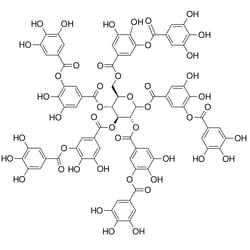
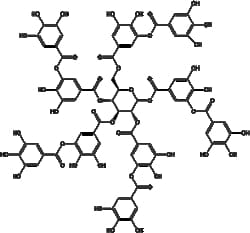
Apexbio Technology LLC Tannic acid 1401-55-4 1g
Tannic acid (CAS 1401-55-4) is a polyphenolic compound classified among hydrolyzable tannins commonly extracted from plant sources such as oak galls It functions as a weak acid and exhibits protein-precipitating activity through non-specific binding to proteins and other macromolecules Tannic acid s ability to modulate protein interactions underlies its astringent antimicrobial and anti-inflammatory properties making it useful in research on barrier protection wound healing and inhibition of pathogenic microorganisms Additionally it is studied for its role in modulating cell adhesion oxidative stress and as an experimental agent in gastrointestinal and dermatological models

Medchemexpress LLC Tannic acid | 1401-55-4 | 81.7% | 10 G
Tannic acid is a novel hERG channel blocker with an IC50 of 3.4 μM.
- Target: Potassium channel
- Research areas: Inflammation/immunology, cancer
- Appearance: Light yellow to yellow solid
- Purity: 81.7%
- Molecular formula: C76H52O46
- Molecular weight: 1701.20
- Storage: Powder at -20°C for 3 years or 4°C for 2 years; in solvent at -80°C for 6 months or -20°C for 1 month.

BIOHIPPO Research Grade Anti-Human CD205/LY75/DEC-205 Biosimilar Antibody (CDX-1401), 100 µg
CDX-1401 is a research-grade biosimilar antibody targeting CD205/LY75/DEC-205. It reacts with Human. Suitable for ELISA, FACS, Functional assay, Research in vivo. This research-grade biosimilar supports comparability, functional, PK/PD and immunogenicity studies. Supplied as 100 ug.

Medchemexpress LLC TMPD (dihydrochloride) | 637-01-4 | 99.3% | 237.17 | 1 G
TMPD (dihydrochloride) | 637-01-4 | 99.3% | 237.17 | 1 G

eMolecules Tannic acid | 1401-55-4 | MFCD00066397 | 25g
Chem-Impex | Tannic acid | 25g | 112757626 | 22921 | | 1401-55-4 | MFCD00066397 | 1701.206 | C76H52O46
If you are unable to find the chemical you are looking for, make sure you are logged into your fishersci.com account and click on the following link:
eMolecules Building Block Tool
Selleck Chemical LLC Tannic acid 25mg 1401-55-4 Gallotannic acid
Tannic acid (Gallotannic acid), a polyphenolic compound, is a CXCL12/CXCR4 inhibitor with antiangiogenic, anti-inflammatory and antitumor activity. *For Research & Development use only. Product is not intended for drug, household, or human consumption.

Medchemexpress LLC Tannic acid | 1401-55-4 | 81.7% | 1 ML
Tannic acid (HY-B2136) is a novel hERG channel blocker with an IC50 of 3.4 μM. Initially sourced from plants like Polygonatum odoratum (Mill.) Druce, this compound is classified as a phenol and polyphenol, offering relevance to research in inflammation/immunology and cancer.
- Novel hERG channel blocker
- IC50 of 3.4 μM
- Derived from Polygonatum odoratum (Mill.) Druce
- Classified as phenol and polyphenol
- Relevant for inflammation/immunology research
- Applicable in cancer research
- Possesses anti-aging properties
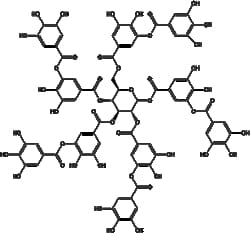
Apexbio Technology LLC Tannic acid 1401-55-4 500mg
Tannic acid (CAS 1401-55-4) is a polyphenolic compound classified among hydrolyzable tannins commonly extracted from plant sources such as oak galls It functions as a weak acid and exhibits protein-precipitating activity through non-specific binding to proteins and other macromolecules Tannic acid s ability to modulate protein interactions underlies its astringent antimicrobial and anti-inflammatory properties making it useful in research on barrier protection wound healing and inhibition of pathogenic microorganisms Additionally it is studied for its role in modulating cell adhesion oxidative stress and as an experimental agent in gastrointestinal and dermatological models

ALADDIN SCIENTIFIC CORPORATION Tannic acid, 100g
Slight special smell strong astringency dark color in exposed light and air Soluble in water soluble in ethanol acetone and glycerol almost insoluble in ether benzene chloroform and petroleum ether Slight special smell with strong astringency Light yellow amorphous powder or loose glossy scaly or spongy solid most of them decompose into pyrogallic acid and carbon dioxide at 210-215 degC 1G in 0 35ml water and 1ml hot glycerin Odorless flammable When it comes to albumin starch gelatin and many alkaloids and metal salts it will precipitate When it comes to iron salts it will also produce black or precipitate The spontaneous combustion point was 526 6 degC and the median lethal dose (rabbit oral) was 5 0 g / kg Tannin is not a single compound and its chemical composition is complex Condensed tannin is a kind of flavanol The 2-position of flavanol in the molecule combines with catechol or pyrogallol through carbon carbon bond Hydrolyzable tannin with ester bond in molecule is ga
Chem-Impex International, Inc. N,N,N',N'-Tetramethyl-p-phenylenediamine dihydrochloride | 637-01-4 | MFCD00012482 | 25G
N,N,N',N'-Tetramethyl-p-phenylenediamine dihydrochloride, 637-01-4, MFCD00012482, 25G